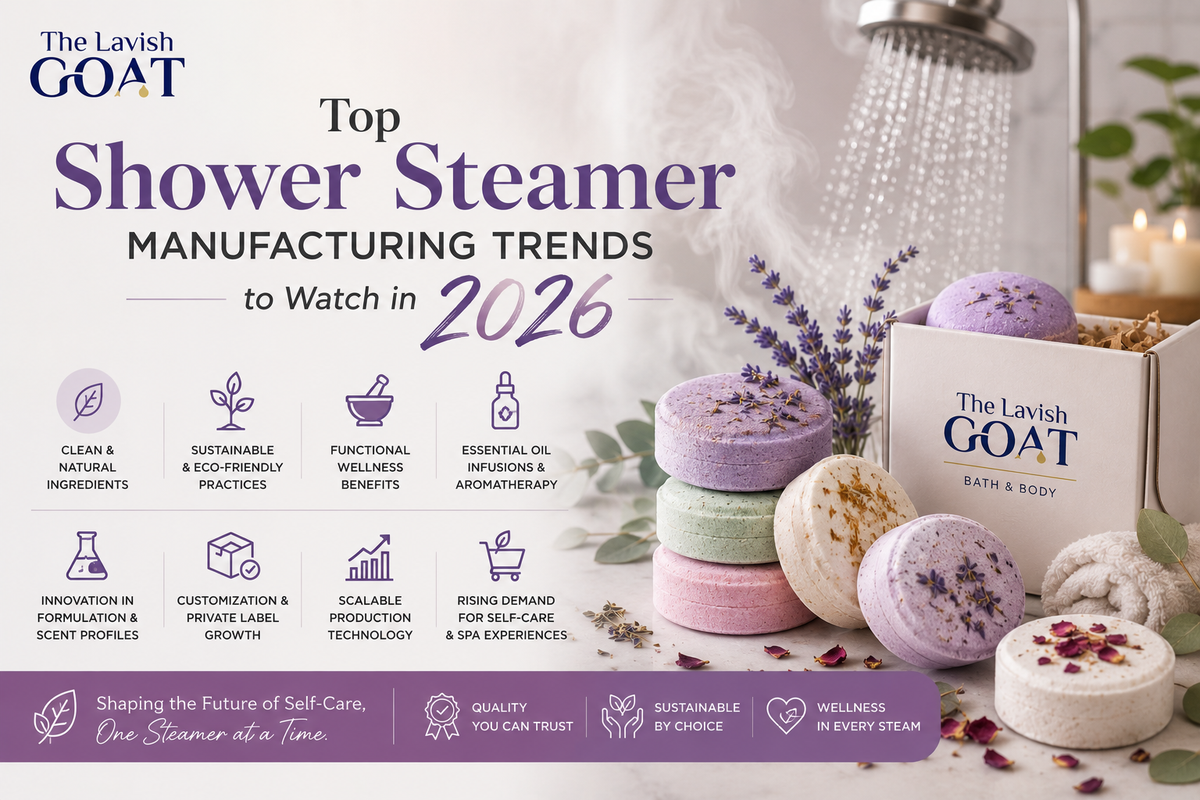
At The Lavish Goat, every shower steamer that leaves our workshop carries a promise: it will fizz the way it's supposed to, smell the way it's supposed to, and turn an ordinary shower into a small daily ritual. That promise doesn't happen by accident. It happens because every batch passes through a series of deliberate quality checks before it ever reaches a customer's bathroom shelf.
Shower steamers look simple. A few pressed ingredients, a splash of essential oil, a satisfying fizz when they hit warm water. But that simplicity is deceptive. Get the moisture content wrong, and a steamer crumbles in the box. Get the oil ratio wrong, and it either barely scents the room or overwhelms it. Skip a quality check, and a customer's relaxing shower turns into a disappointing mess on the shower floor. Here's a look at the checks that matter most, and why we treat them as non-negotiable.
1. Moisture and Cure Time Verification
The single biggest cause of shower steamer failure is moisture, either too much or too little. Shower steamers are built on a base of baking soda and citric acid, the same fizzing reaction found in bath bombs. If the mixture retains too much moisture during mixing or curing, the acid and base react prematurely inside the mold, and the steamer either crumbles, cracks, or loses its fizzing power before it ever reaches the shower.
Before any batch ships, we check that each steamer has cured for the correct amount of time in a controlled, low-humidity environment. This typically means 24 to 48 hours of drying, though the exact window depends on the recipe and the ambient humidity in the workshop that week. A steamer that feels even slightly tacky or soft to the touch doesn't move forward. We also spot-check weight consistency across a batch. A steamer that's noticeably lighter or heavier than its siblings usually signals a moisture or mixing inconsistency that needs to be caught before packaging.
2. Structural Integrity Testing
A shower steamer needs to survive a trip through the mail, a toss into a gift bag, and a bit of handling before it ever gets used. That means every batch goes through a basic drop and handling test. We're checking for chips, cracks, and crumbling edges, since a steamer that arrives in pieces is a steamer that goes straight to a one-star review.
This is also where mold release quality gets checked. Steamers that are pulled from their molds too early or with too much force can develop hairline cracks that aren't visible right away but show up days later as the steamer sits on a shelf. Our team examines the surface and edges of sample steamers from each batch, looking specifically for stress marks near the base or seams where two mold halves meet.
3. Fizz Performance Testing
This is the fun part of quality control, and also one of the most important. A shower steamer's entire job is to release a cloud of fragrant steam when it meets hot water and steam, not to sit there looking pretty. Before a batch is approved, we run water tests on sample pieces, placing them on a wet surface or under a light stream of warm water to confirm the reaction kicks in properly.
We're looking for a few specific things here. Does the steamer start fizzing within a reasonable window, generally a few seconds to under a minute? Does it release fragrance steadily rather than all at once, so the scent lasts through a full shower rather than disappearing in the first 90 seconds? And does it dissolve at a reasonable pace, ideally lasting long enough for a full shower without turning into a puddle of mush in five minutes? A steamer that fizzes too fast, too slow, or too weakly doesn't meet our standard, even if it looks perfect sitting in the box.
4. Fragrance Strength and Consistency
Scent is subjective, but scent strength shouldn't vary wildly from steamer to steamer within the same product line. Uneven essential oil distribution during mixing is a common issue, especially in batches where oils are added by hand rather than through a metered process. If one steamer smells like a spa and the next one from the same batch smells like almost nothing, that's a quality failure, even if both steamers look identical.
Our checks include smell testing multiple samples from the same batch side by side, comparing them against a reference standard for that scent. We also confirm essential oil and fragrance oil percentages stay within the safe and effective range for topical steam inhalation. This matters both for consistency and for safety, since essential oils that are too concentrated can cause skin or respiratory irritation for sensitive users, particularly when steamers are used in an enclosed shower space.
5. Ingredient Safety and Allergen Screening
Because shower steamers release their ingredients as steam that gets breathed in directly, safety review carries extra weight compared to something like a bar soap. Before a new formula or a reformulated batch ships, we double-check every ingredient against known skin and respiratory sensitivities. Certain essential oils, like specific citrus or menthol-heavy blends, need to stay under particular concentration thresholds to avoid irritation for people with asthma or sensitive skin.
We also verify that ingredient labeling on the packaging matches what's actually in the product, down to the specific oils and any color additives used. This isn't just a legal formality. Customers rely on accurate labeling to avoid allergens or sensitivities, and a mismatch between the label and the actual formula is a serious quality failure regardless of how good the steamer performs otherwise.
6. Color Stability and Appearance
A shower steamer's color often signals its scent before a customer even opens the box, a lavender steamer should look lavender, a citrus one should look bright and warm. Color bleeding, fading, or uneven distribution throughout the steamer is a sign of a mixing issue and gets flagged during review.
We also check for surface consistency, since visible air pockets, discoloration, or an uneven texture on the surface can hint at problems with the pressing or curing process, even if the steamer performs fine functionally. Appearance matters because it's the first quality signal a customer sees, well before they ever turn on the shower.
7. Packaging and Shelf-Life Checks
The final check happens right before a steamer goes into its packaging. We confirm that the packaging itself protects against moisture exposure, since even a perfectly cured steamer can start absorbing ambient humidity if it sits in a poorly sealed bag or box for weeks. Individually wrapped steamers get a seal integrity check to make sure there are no gaps letting moisture creep in during storage or shipping.
We also track batch dates so every steamer that ships has a known cure date and an estimated shelf life, typically several months when stored properly. This lets us rotate stock and ensures customers never receive a steamer that's been sitting around well past its ideal freshness window.
Why This Level of Detail Matters
None of these checks happen because a customer asked for them directly. They happen because a shower steamer that crumbles, underperforms, or smells inconsistent breaks the trust that makes someone come back to The Lavish Goat for their next order. Quality control isn't a final step tacked onto the end of production, it's woven through moisture testing, structural checks, fizz performance, fragrance consistency, safety screening, appearance, and packaging.
The result is a shower steamer that does exactly what it promises: turns on, fizzes properly, fills the shower with a consistent, pleasant scent, and holds up from our workshop to your bathroom shelf.
Final Thoughts
A shower steamer is a small product, but it carries a lot of expectation in a small package. Customers aren't just buying a scent, they're buying a few minutes of calm at the start or end of a long day, and that experience only works if the product behaves the way it's supposed to every single time. That's why quality control at The Lavish Goat isn't treated as a box to check before shipping, it's built into every stage of the process, from the moment ingredients are measured to the moment a steamer is sealed in its final packaging.
The checks outlined here, moisture and cure verification, structural testing, fizz performance, fragrance consistency, safety screening, appearance, and packaging integrity, exist because any one of them, left unchecked, can undo an otherwise good product. A steamer that looks beautiful but crumbles in shipping fails the customer just as much as one that fizzes perfectly but was mislabeled for allergens. Real quality control means every one of these checks passes together, consistently, batch after batch.
That consistency is really what The Lavish Goat is selling. Not just a single great shower steamer, but the confidence that the next one, and the one after that, will feel just as good. It's a quiet kind of promise, but it's one we take seriously with every batch that leaves our workshop.